
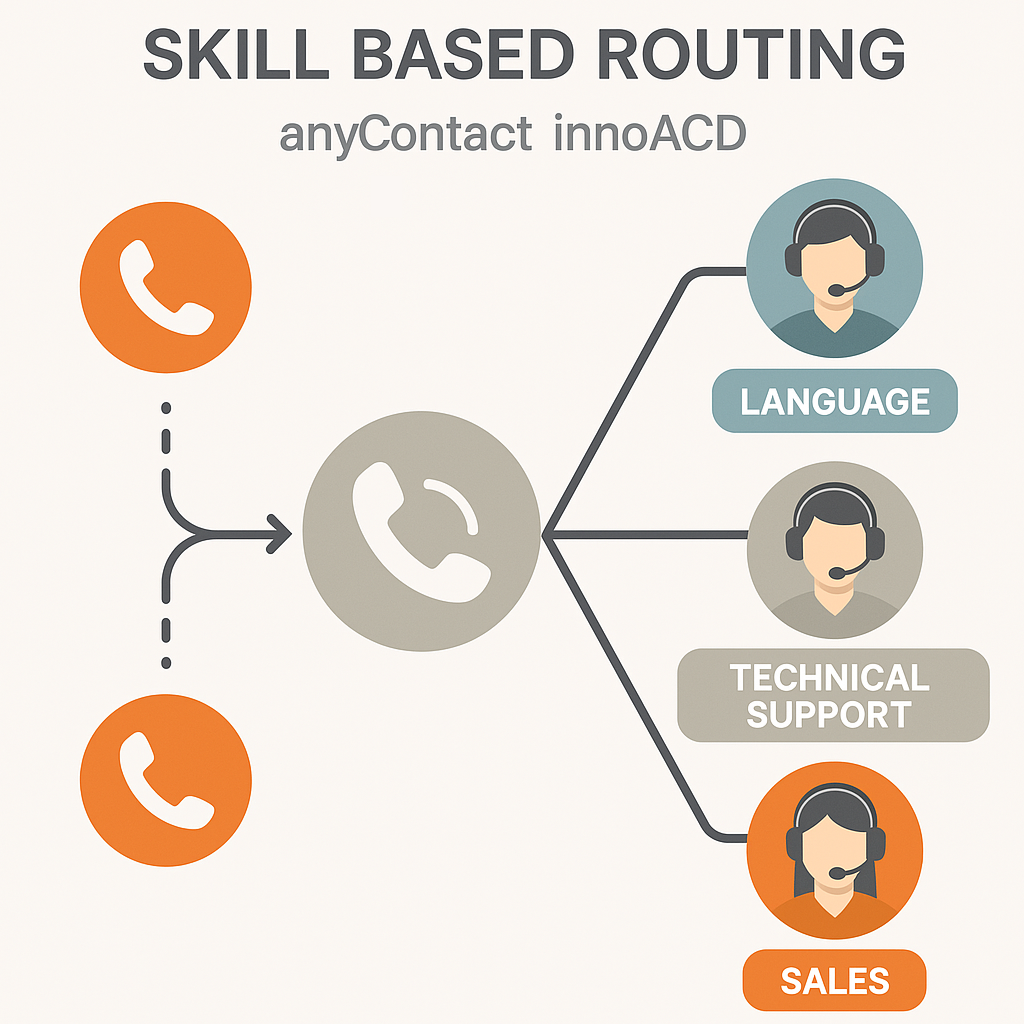
anyContact innoACD offers a powerful, fully integrated implementation of Skill-Based Routing (SBR) based on the innovaphone App Platform. The goal is to intelligently distribute incoming calls to exactly those agents whose qualifications (skills) best match the caller’s needs.
Unlike simple call distribution strategies that rely solely on availability or fixed agent assignments, Skill-Based Routing enables skill-oriented distribution — resulting in higher efficiency, improved customer experience, and better resource utilization.
Central Role of Waiting Queues
Call distribution takes place via Waiting Queues, which serve as central control units in the innovaphone PBX. Each Waiting Queue represents a thematic or organizational queue (e.g., “Technical Support,” “Sales,” “1st Level IT”). For each of these queues, skill requirements can be defined — either as mandatory or optional. In addition, skills within a queue can be weighted against each other.
These skill requirements determine which agents may be considered for incoming calls. Only agents who possess the required skills will receive the call signal and be able to answer. This ensures that calls are routed only to qualified personnel.
The skill configuration is done via the AC Queue Admin app and can be adjusted individually for each Waiting Queue.
Objectives and Benefits
The introduction of Skill-Based Routing with anyContact innoACD pursues clear operational and customer-focused objectives:
-
Increased First Call Resolution: Calls are routed directly to competent agents, reducing rework and escalations.
-
Improved Customer Satisfaction: Customers receive qualified assistance faster and without transfers.
-
Optimized Agent Utilization: Agents are used in line with their actual skills.
-
Reduced Call Duration: Efficient call routing reduces average handling time.
Dynamic Routing Evaluation in innoACD
Building on the skill requirements, innoACD extends the routing logic with a dynamic evaluation system that calculates a routing score for every call–agent combination. This score is based on three factors:
-
Skill level of the agent for the required skill
-
Waiting time of the call in the queue
-
Agent workload, measured as the ratio of talk time to login time
The weighting of these factors is defined per queue and determines how strongly each aspect influences the distribution. What matters is the ratio between the weights, not the absolute values. This allows the routing to be flexibly balanced between subject-matter expertise, reduced waiting times, or even workload distribution.
Application Strategies
With this mechanism, different routing strategies can be applied depending on the use case:
-
Skill-focused – prioritizes highly qualified agents for complex support requests
-
Waiting-time oriented – gives priority to calls that have been in the queue the longest, ideal for standard inquiries
-
Workload balancing – ensures even distribution of calls across teams with similar qualification levels
-
VIP-oriented – prioritizes specific customer groups via dedicated skills and queues
-
Emergency routing – immediately assigns critical calls exclusively to specially trained agents
Interaction of Multiple Queues
In scenarios with different types of requests, such as in an insurance or service center, multiple queues can run in parallel and be connected through overflow mechanisms. This way, service agents can take over simple specialist inquiries when needed, or specialist agents can support the service queue during peak times. As a result, the system remains flexible, reduces waiting times, and ensures a proper match between request and expertise.