
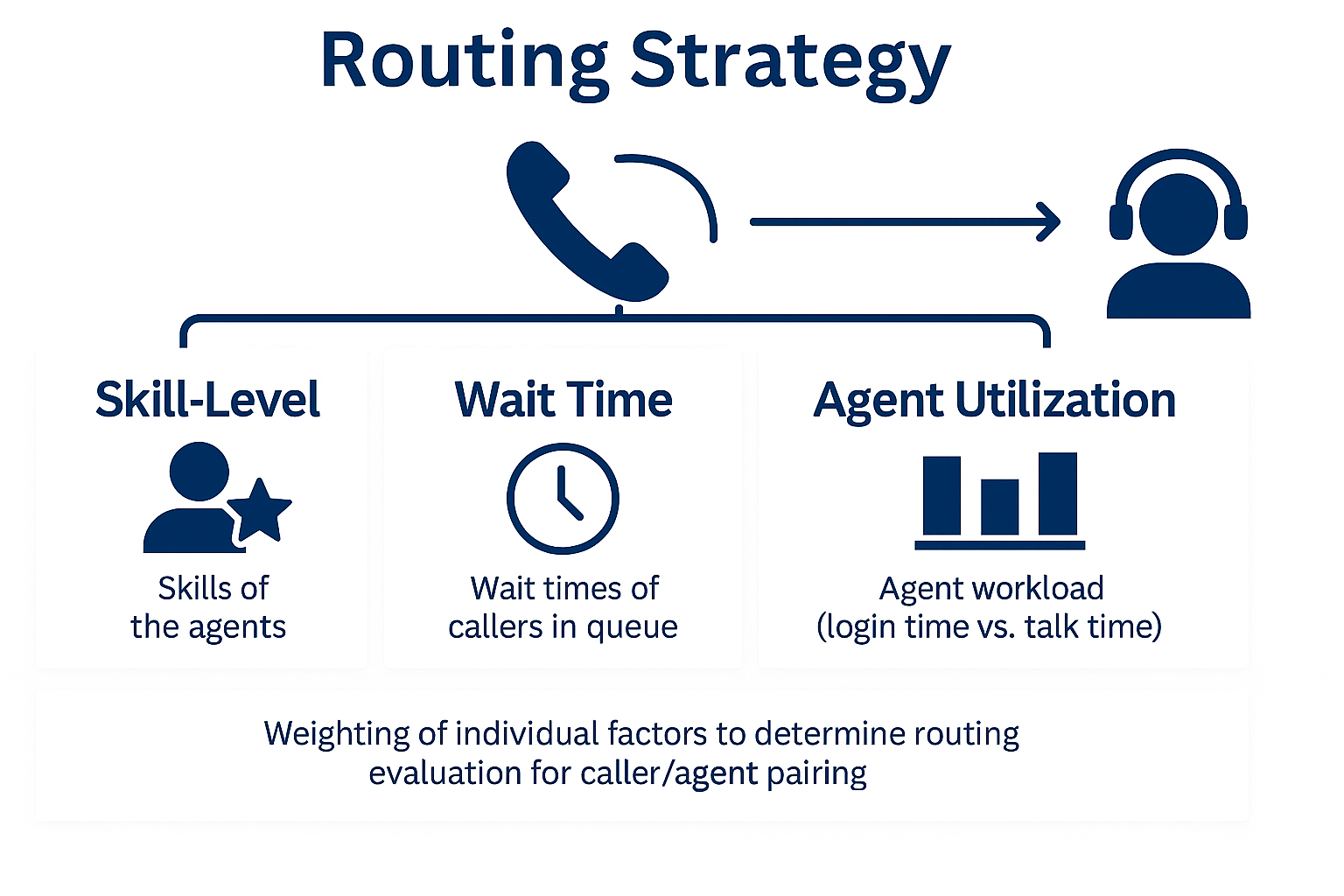
Call routing in innoACD is based on a dynamic evaluation system.
For each combination of an incoming call and an agent, a routing evaluation is calculated. This evaluation determines which agent will handle the call.
The routing evaluation is based on three factors:
-
The agent's skill level for the topic of the call
-
The call’s waiting time in the queue
-
The agent’s utilization (ratio of talk time to total login time)
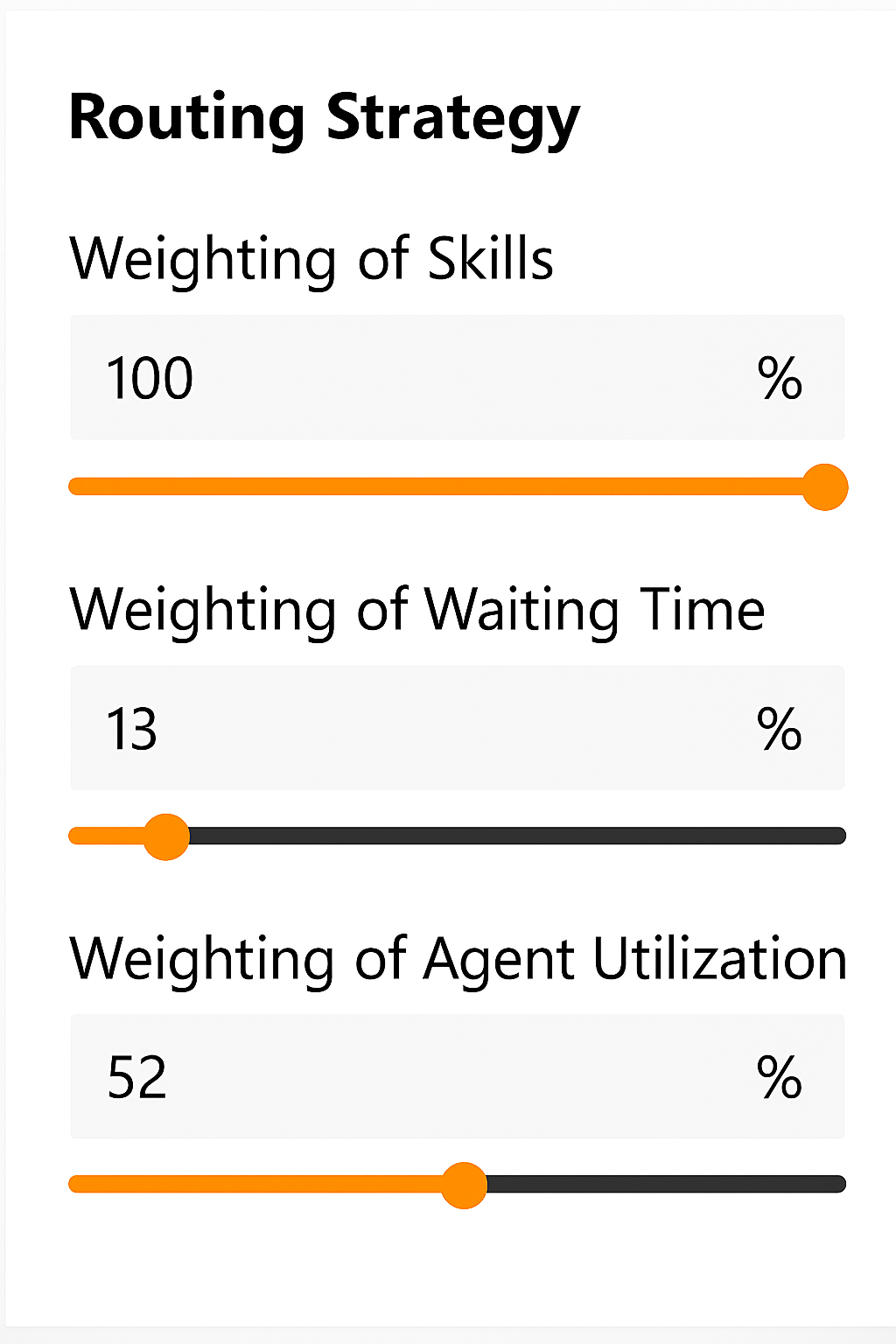
The weighting of these factors is configured individually per queue.
The higher the weighting of a factor, the more influence it has on the routing evaluation.
The agent’s skill level plays a key role: agents with a higher skill level receive a higher evaluation with equal weighting and are therefore prioritized.
Important Note on Weighting
The key factor influencing routing behavior is not the absolute value of each individual weighting, but rather the ratio between the weights.
This means:
A routing strategy with 30% / 30% / 40% will result in exactly the same behavior as one with 60% / 60% / 80% – because the ratio (3:3:4) is identical.
The weightings therefore define the relative importance of each factor compared to the others, not their standalone impact.
Example:Both strategies slightly prioritize agent utilization over the other two factors.
The routing behavior remains identical.
|
Faktor |
Strategie A |
Strategie B |
|---|---|---|
|
Skill |
30% |
60% |
|
Waitingtime |
30% |
60% |
|
Agent utilization |
40 % |
80 % |
Why is this important?
-
What matters is which factor is weighted more heavily—not how high the absolute values are.
-
An equal weighting of all three factors (e.g., 50% / 50% / 50%) results in balanced routing, regardless of whether the values are 10%, 50% or 90%.
-
If one factor is weighted higher relative to the others, it will have greater influence on the routing evaluation and thus on the selection of the call-agent pairing.
Examples of Different Routing Strategies
Skill-Oriented Routing
Scenario:
A customer calls with a complex technical issue, such as system integration or error analysis. Handling the request requires solid expertise and experience.
Queue: IT Hotline
Strategy:
-
Skill level: 80%
-
Waiting time: 10%
-
Agent utilization: 10%
Explanation:
This strategy focuses on the qualification of the agent. The routing evaluation is heavily influenced by the agent’s skill level.
Agents with strong expertise receive the highest evaluation and are prioritized—even if other agents are less utilized.
This ensures that complex inquiries are handled accurately and efficiently, rather than simply quickly.
Speed over Specialization
Scenario:
A call center receives a high volume of simple inquiries—e.g., about business hours, delivery status, or general information. The topics are easy to answer and do not require in-depth expertise.
Queue: Delivery Status Inquiry
Strategy:
-
Skill level: 30%
-
Waiting time: 60%
-
Agent utilization: 10%
Explanation:
This strategy focuses on minimizing wait times. The routing evaluation is primarily influenced by how long the call has been waiting in the queue.
Calls with longer wait times receive higher evaluations—even if the agent is not perfectly qualified.
The goal is to improve accessibility and reduce waiting times during high call volumes.
Agent availability is more important than specialization. However, highly skilled agents are still prioritized if they are available.
Even Distribution
Situation:
A support team with similar qualifications should be evenly utilized. The goal is to avoid overloading individual agents and to distribute the workload fairly.
Queue: Support
Strategy:
-
Skill level: 30%
-
Waiting time: 30%
-
Agent utilization: 40%
Explanation:
The routing score considers all three factors relatively evenly, with a slight emphasis on agent utilization. Agents who are less busy are preferentially assigned new calls. At the same time, it is ensured that waiting times do not become too long and that qualifications are sufficient.
This strategy is particularly suitable for homogeneous teams with equivalent expertise.
No strong specialization is necessary. Even distribution is enabled through similar scoring.
VIP Treatment (simulated via Queue)
Situation:
A premium customer is calling. VIP recognition is done through a separate queue and a special skill "VIP." The goal is to prioritize these customers—even without automatic number recognition.
Queue: VIP Calls
Strategy:
-
Skill level: 70%
-
Waiting time: 20%
-
Agent utilization: 10%
Agent Skill Levels:
-
Skill "VIP": 90–100% skill level
-
Other skills: weighted lower (e.g., 50%)
Explanation:
The routing score is strongly influenced by the skill level. Agents with the "VIP" skill receive a higher rating due to their high skill level. The separate queue ensures VIP calls do not compete with standard inquiries.
This strategy simulates VIP routing until automatic recognition becomes available.
This ensures that VIP calls are given priority treatment
Emergency Routing via Emergency Queue
Situation:
An alarm call comes in, e.g., from a security or health area. The handling must be immediate and performed by specially trained agents.
Queue: Emergency
Strategy:
-
Skill level: 100%
-
Waiting time: 0%
-
Agent utilization: 0%
Agent Skill Levels:
-
Skill “Emergency”: 100% skill level
-
Other skills: deliberately lower (e.g., 50%) to ensure prioritization
Explanation:
This strategy is based solely on skill level. As soon as an agent with the “Emergency” skill at 100% skill level is available, the call is assigned immediately—regardless of waiting times in other queues or agent utilization.
This guarantees a fast and professionally correct handling of critical calls.
Comparison of three Queues in an Insurance Contact Center with Routing Overflows
Efficient call distribution is key to customer satisfaction and resource optimization in insurance contact centers. Different types of inquiries—from simple service requests to urgent or complex issues require tailored handling.
This model uses three queues:
-
Emergency Queue for urgent matters,
-
Expertise Queue for complex inquiries,
-
Service Queue for simple, quick tasks.
Skill-based routing and overflow mechanisms allow qualified agents to support multiple queues as needed, minimizing wait times and maximizing service quality.
|
Aspect |
Emergency Queue (e.g. escalations, executive inquiries) |
Expert Queue (e.g. life insurance) |
Service Queue (e.g. address changes, general inquiries) |
|---|---|---|---|
|
Objective |
Immediate handling of urgent matters |
Professionally sound handling of complex cases |
Even workload distribution and fast processing |
|
Example Requests |
Escalated claims, complaints, board-level inquiries |
Pension calculation, contract optimization |
IBAN change, response to letters, shipping status |
|
Skill Level Weighting |
100% |
80% |
30% |
|
Wait Time Weighting |
0% |
10% |
30% |
|
Agent Workload Weighting |
0% |
10% |
40% |
|
Routing Strategy |
Any available agent with the emergency skill takes the call immediately – top priority in the system |
Preference for agents with strong expertise; service agents assist when needed |
Preference for less-burdened service agents; expert agents step in only when necessary |
Sample Skill Levels
|
Agent Type |
Skill: Emergency |
Skill: Life Insurance |
Skill: Address Changes & Inquiries |
|---|---|---|---|
|
Expert Agents |
100% |
High (e.g. 80%) |
Low (e.g. 30%) |
|
Service Agents |
100% |
Low (e.g. 30%) |
High (e.g. 80%) |
All agents in the system have the "Emergency" skill at 100%, making them equally qualified to take emergency calls immediately.
Prioritization & Routing Logic
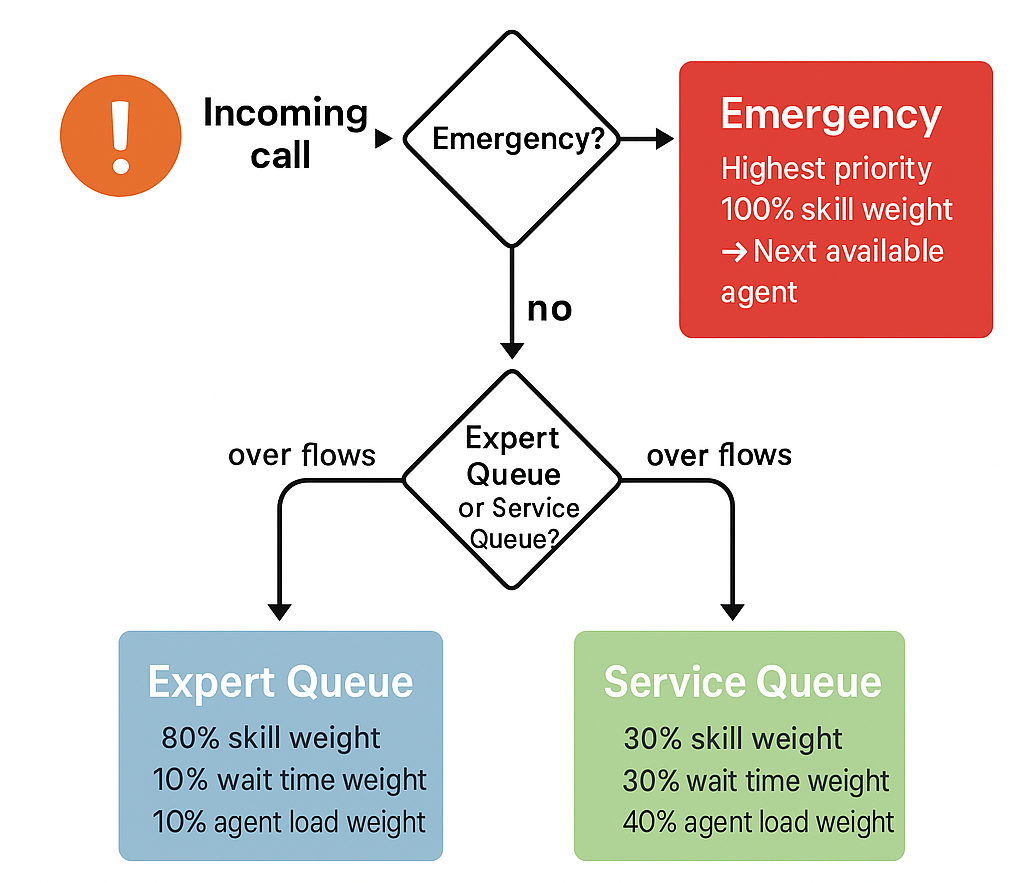
The Emergency Queue has absolute priority, because:
-
The skill factor is weighted at 100% in the routing strategy
-
Agents possess 100% competence in the emergency skill
As a result, emergency requests always receive the highest possible routing evaluation, regardless of wait time or agent workload.
➡️ Whenever an emergency call comes in, it is always routed first – to the next available agent, before any calls in the Expert or Service Queues are considered.
Interaction Between Queues
While emergency calls are always prioritized, Expert and Service Queues continue to distribute calls intelligently based on:
-
Skill Level
-
Wait Time
-
Current Workload
Overflow routing between the queues ensures flexibility:
-
Service agents can handle Expert requests (if needed and sufficiently skilled)
-
Expert agents can step into Service tasks if no one else is available
Queue Registration Requirement
Agents must be explicitly registered in the respective queue to be eligible for call routing. This applies to:
-
the Expert Queue (e.g. life insurance),
-
the Service Queue (e.g. address changes),
-
and also the Emergency Queue.
Even though all agents have the "Emergency" skill at 100%, they will only be considered for emergency calls if they are registered in the Emergency Queue.
This allows:
-
Defined emergency teams
-
Duty or on-call shifts
-
Temporary scaling during peak times
Summary
✅ 100% weight + 100% skill level in emergency routing ensures immediate call allocation
✅ Emergency calls are always handled with highest priority – even before expert or service topics
✅ All agents are technically and professionally qualified to take emergency calls
✅ Expert and Service Queues use proven routing based on skill, wait time, and workload
✅ Overflow logic between queues ensures high availability and operational flexibility